
Imatge
Àmbits Temàtics
Àmbits de Treball
Today’s teens are navigating a digital landscape unlike the one experienced by their predecessors, particularly when it comes to the pervasive presence of social media. In 2022, Pew Research Center fielded an in-depth survey asking American teens – and their parents – about their experiences with and views toward social media. Here are key findings from the survey:
How we did this
Majorities of teens report ever using YouTube, TikTok, Instagram and Snapchat. YouTube is the platform most commonly used by teens, with 95% of those ages 13 to 17 saying they have ever used it, according to a Center survey conducted April 14-May 4, 2022, that asked about 10 online platforms. Two-thirds of teens report using TikTok, followed by roughly six-in-ten who say they use Instagram (62%) and Snapchat (59%). Much smaller shares of teens say they have ever used Twitter (23%), Twitch (20%), WhatsApp (17%), Reddit (14%) and Tumblr (5%).
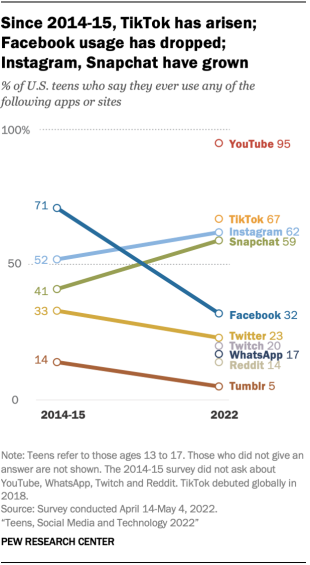
Facebook use among teens dropped from 71% in 2014–15 to 32% in 2022. Twitter and Tumblr also experienced declines in teen users during that span, but Instagram and Snapchat saw notable increases.
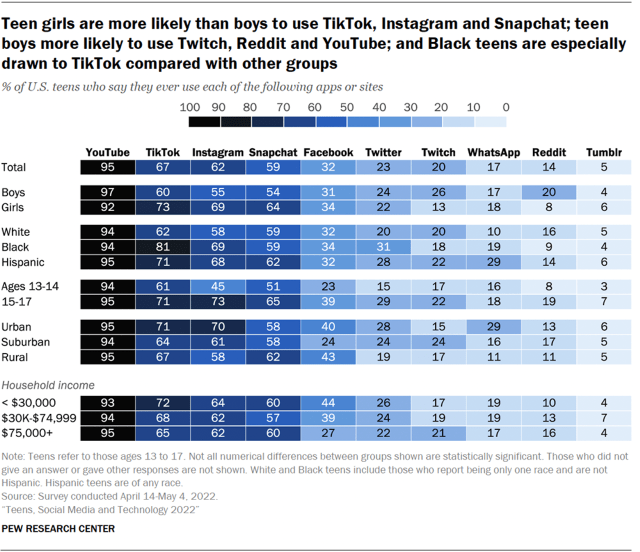
TikTok use is more common among Black teens and among teen girls. For example, roughly eight-in-ten Black teens (81%) say they use TikTok, compared with 71% of Hispanic teens and 62% of White teens. And Hispanic teens (29%) are more likely than Black (19%) or White teens (10%) to report using WhatsApp. (There were not enough Asian teens in the sample to analyze separately.)
Teens’ use of certain social media platforms also varies by gender. Teen girls are more likely than teen boys to report using TikTok (73% vs. 60%), Instagram (69% vs. 55%) and Snapchat (64% vs. 54%). Boys are more likely than girls to report using YouTube (97% vs. 92%), Twitch (26% vs. 13%) and Reddit (20% vs. 8%).
Majorities of teens use YouTube and TikTok every day, and some report using these sites almost constantly. About three-quarters of teens (77%) say they use YouTube daily, while a smaller majority of teens (58%) say the same about TikTok. About half of teens use Instagram (50%) or Snapchat (51%) at least once a day, while 19% report daily use of Facebook.
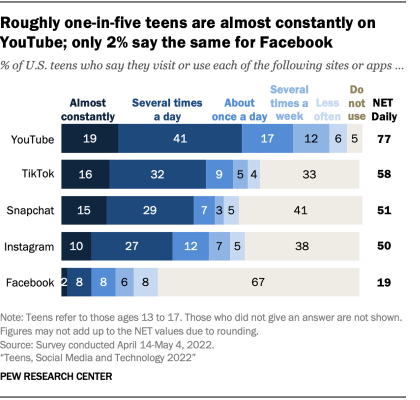
Some teens report using these platforms almost constantly. For example, 19% say they use YouTube almost constantly, while 16% and 15% say the same about TikTok and Snapchat, respectively.
More than half of teens say it would be difficult for them to give up social media. About a third of teens (36%) say they spend too much time on social media, while 55% say they spend about the right amount of time there and just 8% say they spend too little time. Girls are more likely than boys to say they spend too much time on social media (41% vs. 31%).
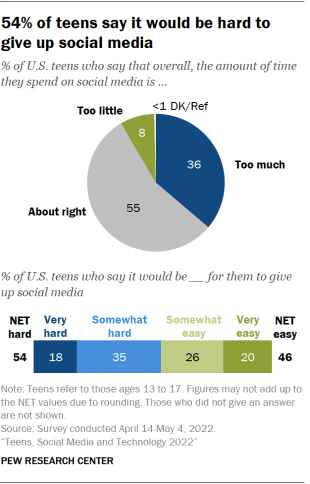
Teens are relatively divided over whether it would be hard or easy for them to give up social media. Some 54% say it would be very or somewhat hard, while 46% say it would be very or somewhat easy.
Girls are more likely than boys to say it would be difficult for them to give up social media (58% vs. 49%). Older teens are also more likely than younger teens to say this: 58% of those ages 15 to 17 say it would be very or somewhat hard to give up social media, compared with 48% of those ages 13 to 14.
Teens are more likely to say social media has had a negative effect on others than on themselves. Some 32% say social media has had a mostly negative effect on people their age, while 9% say this about social media’s effect on themselves.
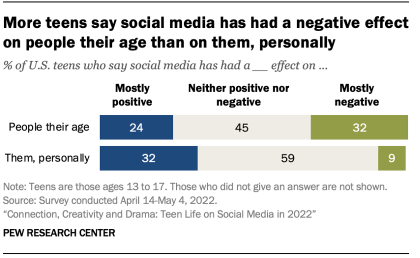
Conversely, teens are more likely to say these platforms have had a mostly positive impact on their own life than on those of their peers. About a third of teens (32%) say social media has had a mostly positive effect on them personally, while roughly a quarter (24%) say it has been positive for other people their age.
Still, the largest shares of teens say social media has had neither a positive nor negative effect on themselves (59%) or on other teens (45%). These patterns are consistent across demographic groups.
Teens are more likely to report positive than negative experiences in their social media use. Majorities of teens report experiencing each of the four positive experiences asked about: feeling more connected to what is going on in their friends’ lives (80%), like they have a place where they can show their creative side (71%), like they have people who can support them through tough times (67%), and that they are more accepted (58%).
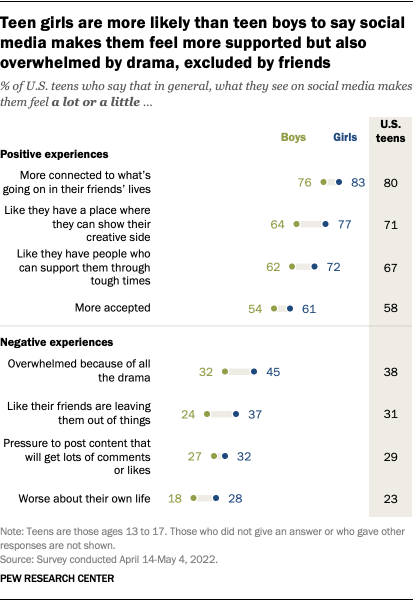
When it comes to negative experiences, 38% of teens say that what they see on social media makes them feel overwhelmed because of all the drama. Roughly three-in-ten say it makes them feel like their friends are leaving them out of things (31%) or feel pressure to post content that will get lots of comments or likes (29%). And 23% say that what they see on social media makes them feel worse about their own life.
There are several gender differences in the experiences teens report having while on social media. Teen girls are more likely than teen boys to say that what they see on social media makes them feel a lot like they have a place to express their creativity or like they have people who can support them. However, girls also report encountering some of the pressures at higher rates than boys. Some 45% of girls say they feel overwhelmed because of all the drama on social media, compared with 32% of boys. Girls are also more likely than boys to say social media has made them feel like their friends are leaving them out of things (37% vs. 24%) or feel worse about their own life (28% vs. 18%).
When it comes to abuse on social media platforms, many teens think criminal charges or permanent bans would help a lot. Half of teens think criminal charges or permanent bans for users who bully or harass others on social media would help a lot to reduce harassment and bullying on these platforms.
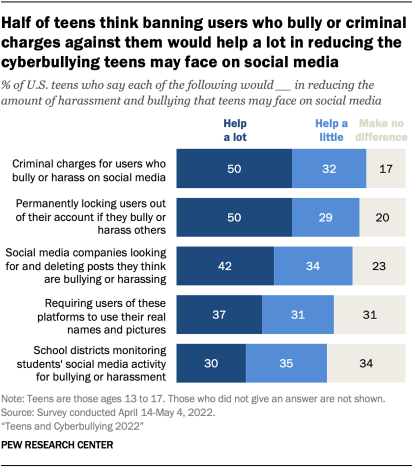
About four-in-ten teens say it would help a lot if social media companies proactively deleted abusive posts or required social media users to use their real names and pictures. Three-in-ten teens say it would help a lot if school districts monitored students’ social media activity for bullying or harassment.
Some teens – especially older girls – avoid posting certain things on social media because of fear of embarrassment or other reasons. Roughly four-in-ten teens say they often or sometimes decide not to post something on social media because they worry people might use it to embarrass them (40%) or because it does not align with how they like to represent themselves on these platforms (38%). A third of teens say they avoid posting certain things out of concern for offending others by what they say, while 27% say they avoid posting things because it could hurt their chances when applying for schools or jobs.
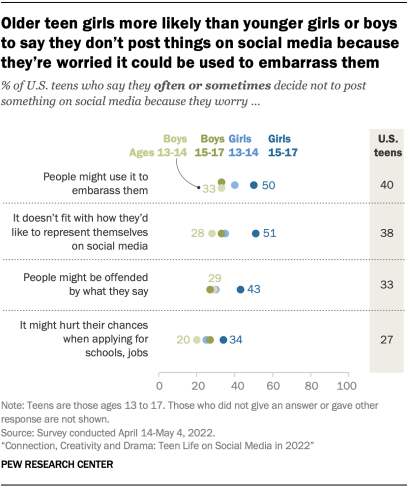
These concerns are more prevalent among older teen girls. For example, roughly half of girls ages 15 to 17 say they often or sometimes decide not to post something on social media because they worry people might use it to embarrass them (50%) or because it doesn’t fit with how they’d like to represent themselves on these sites (51%), compared with smaller shares among younger girls and among boys overall.
Many teens do not feel like they are in the driver’s seat when it comes to controlling what information social media companies collect about them. Six-in-ten teens say they think they have little (40%) or no control (20%) over the personal information that social media companies collect about them. Another 26% aren’t sure how much control they have. Just 14% of teens think they have a lot of control.
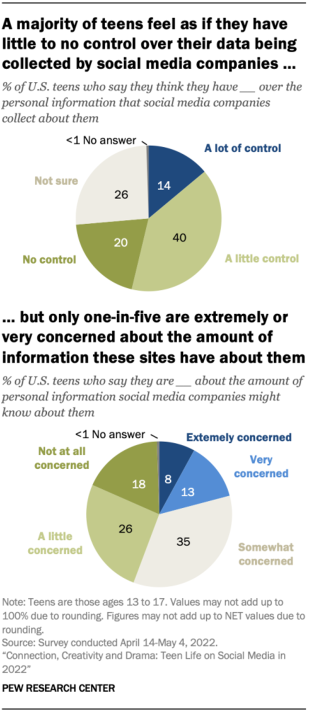
Despite many feeling a lack of control, teens are largely unconcerned about companies collecting their information. Only 8% are extremely concerned about the amount of personal information that social media companies might have and 13% are very concerned. Still, 44% of teens say they have little or no concern about how much these companies might know about them.
Only around one-in-five teens think their parents are highly worried about their use of social media. Some 22% of teens think their parents are extremely or very worried about them using social media. But a larger share of teens (41%) think their parents are either not at all (16%) or a little worried (25%) about them using social media. About a quarter of teens (27%) fall more in the middle, saying they think their parents are somewhat worried.
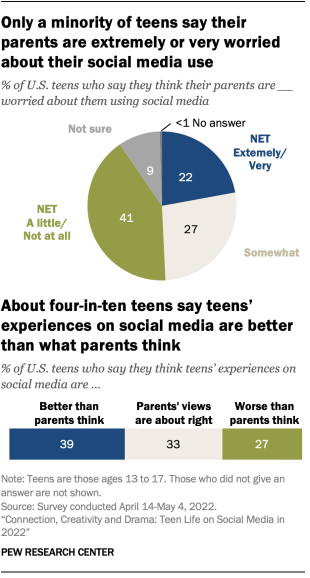
Many teens also believe there is a disconnect between parental perceptions of social media and teens’ lived realities. Some 39% of teens say their experiences on social media are better than parents think, and 27% say their experiences are worse. A third of teens say parents’ views are about right.
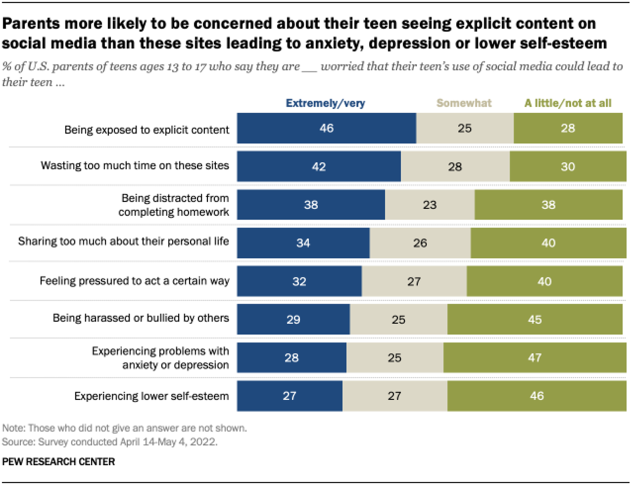
Nearly half of parents with teens (46%) are highly worried that their child could be exposed to explicit content on social media. Parents of teens are more likely to be extremely or very concerned about this than about social media causing mental health issues like anxiety, depression or lower self-esteem. Some parents also fret about time management problems for their teen stemming from social media use, such as wasting time on these sites (42%) and being distracted from completing homework (38%).
Note: Here are the questions used for this report, along with responses, and its methodology.
CORRECTION (May 17, 2023): In a previous version of this post, the percentages of teens using Instagram and Snapchat daily were transposed in the text. The original chart was correct. This change does not substantively affect the analysis.