
Big Tech spends 113 million euros per year on lobbying in Brussels
The digital industry spends more than 113 million euros on lobbying in Brussels – a huge increase since 2021. This is shown by the updated figures of the study we published with LobbyControl in 2021 on the lobbying power and influence of digital corporations.
This article was written and originally published by LobbyControl.
Two years ago, LobbyControl and CEO published a report on the power of the digital industry, which for the first time traced the lobbying activities of tech corporations in detail. We have updated the data and figures and find that Big Tech’s lobbying power continues to grow: From 97 to 113 million euros per year – a 16.5 per cent increase compared to 2021.
Amazon, Google and Co. remain at the top
A total of 651 companies and associations are trying to influence the EU in the digital economy sector. However, the large tech corporations such as Google, Amazon and Meta are primarily responsible for the increase in lobby spending: the top 10 digital corporations alone spend a total of €40 million on lobbying. That’s more than a third of the total sector’s spending.
Despite a slight increase in the number of companies, Big Tech continues to dominate the sector: while 75 per cent of companies spend less than 200,000 euros on lobbying and 25 per cent of them even less than 5,000 euros, at the top end, the tech giants have in some cases more than doubled their spending.
Meta has highest lobby spending and most lobbyists
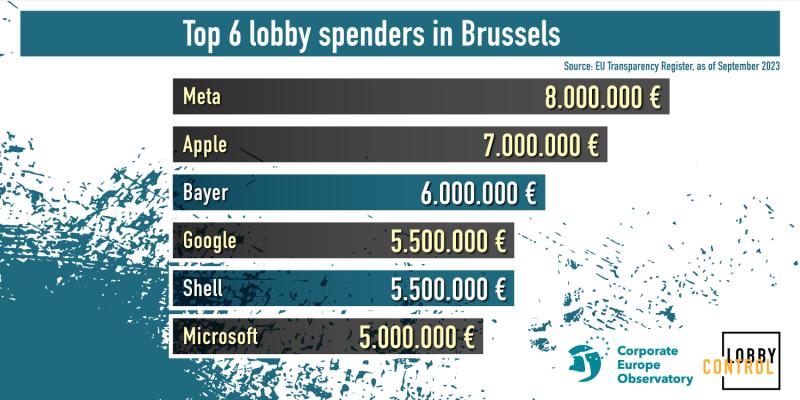
The company with the highest lobby spending is Meta, formerly Facebook: The group has increased its spending from 5.75 million euros in 2021 to 8 million euros today, putting it at the top of the EU’s transparency register of all companies. Apple follows behind: the group doubled its lobby spending from 3.5 to 7 million euros. Semiconductor manufacturer Qualcomm’s spending also grew significantly since 2021: with an increase from 1.75 to 4 million euros, it replaces Huawei in fifth place in the ranking.
Meta is also at the top in terms of the number of lobbyists: with 17.05 full-time equivalents (FTEs), Meta replaces Huawei (11 FTEs). It is followed by companies such as Intel (10 FTEs) and IBM (7.25 FTEs). In addition, Google (from 5.5 to 8.7 FTEs), Amazon (from 5 to 8 FTEs) and Apple (from 4.5 to 7.5 FTEs) also employ more lobbyists than they did in 2021. As a result, Big Tech is getting stronger – not only in terms of its lobby spending, but also the number of lobbyists it employs.
Imbalances worsen
Apart from the huge increase in lobbying budgets, the companies with the highest spending remain largely the same as in 2021. Newcomers to the top 10 are the telecommunications companies Telefonica (from 1.5 to 2 million euros) and Deutsche Telekom (from 1 to 2 million euros), which have greatly increased their lobbying spending compared with 2021. Overall, the figures clearly show that the imbalances within the sector have worsened, and that lobby power is concentrated even more than before among the large corporations.
Chinese Big Tech still far behind US groups
Geographical imbalances also remain: Just under 20 per cent of the companies lobbying on behalf of the digital economy in the EU are headquartered in the US. The shares for European countries such as Germany, France, and the UK have declined only slightly and are each at around 10 per cent. The share of companies from China remains low (< 1 per cent). Big Chinese tech groups such as TikTok (€900,000) and Alibaba (€600,000) are also represented in the upper range, but do not spend as much as their U.S. counterparts.
Limiting the power of Big Tech
Overall, the comparison with 2021 shows that Big Tech companies are using more and more resources to try to influence EU policy in their favor. The increased lobbying is not least related to the enormous workload of legislation in the digital sector. In addition to the Digital Markets Act (DMA) and the Digital Services Act (DSA), for example, the use of artificial intelligence is currently being regulated by law. In order to limit the lobbying power of Amazon, Google an Co., we therefore need stricter rules against unilateral lobbying at the EU level, but also an ambitious application of the Digital Markets Act (DMA) to decisively limit the economic monopoly power of digital corporations.
2021 data updateA lot has changed in the digital sector in two years. To capture these changes, we have updated the data collected in 2021 using our online data tool www.lobbyfacts.eu (as of August 2023). We have removed smaller companies that are now no longer in the transparency register from our data. To identify new lobby players, we then repeated the analysis steps from the 2021 report. In the process, we added many new companies and startups in particular that are active in the fields of artificial intelligence (AI), FinTech or digital identification. In total, we identified 651 companies and associations that lobby Brussels from the digital sector. For the calculations, we again used the lower limits of the specified expenditure categories from the transparency register. Except for the lowest category (<€10,000), we calculated the mean value (€5,000) and thus arrive at a rather conservative estimate of lobby spending. Most of the data refer to 2022, but as the entries in the transparency register are only updated annually and by the companies themselves, they may be one or two years older. Further information on the data basis can be found in the 2021 study. |