

Dozens of advertisers instructed the company to not show their ads to people of “unknown” gender, meaning people who had not identified themselves as male or female By Jeremy B. Merrill
Google’s advertising system allowed employers or landlords to discriminate against nonbinary and some transgender people, The Markup found.
Companies trying to run ads on YouTube or elsewhere on the web could direct Google not to show those ads to people of “unknown gender”—meaning people who have not identified themselves to Google as “male” or “female.” After being alerted to this by The Markup, Google pledged to crack down on the practice.
“We will be implementing an update to our policy and enforcement in the coming weeks to restrict advertisers from targeting or excluding users on the basis of the ‘gender unknown’ category, ” Elijah Lawal, a spokesperson for Google said.
Google’s policies forbid ads targeting or excluding male or female people from jobs, housing, or financial products, in order to comply with federal anti-discrimination laws. But until The Markup alerted Google, the company gave advertisers the option of keeping their ads from being shown to people of “unknown gender”—effectively allowing employers and landlords to either inadvertently or purposefully discriminate against people who identify as nonbinary, transgender, or anything other than male or female.
The Markup found two such job ads on YouTube, which is owned by Google—one for jobs at FedEx and the other for Dewey Pest Control, a California-based chain. In both cases, Google’s ad targeting explanations, collected by New York University’s Ad Observer, indicated that the employer had targeted the ad based on gender but that the data did not specify which gender was targeted. In those cases, Lawal said, the advertiser had chosen to exclude people of unknown gender from seeing the ads. Upon further review, Lawal said, the company “identified approximately 100 advertisers out of many thousands” who had done the same for housing, credit, or job ads.
A FedEx spokesperson, Shannon Davis, said FedEx declined to comment “on our specific marketing or recruiting processes.” Dewey Pest Control didn’t respond to a request for comment.
It’s not clear if the advertisers meant to prevent nonbinary people or those identifying as transgender from finding out about job openings.
That would be “completely unethical and I think dangerous to society as a whole, ” said Joseph Turow, a professor of communication at the University of Pennsylvania.
Lawal said that Google’s existing written policies forbid excluding people on the basis of transgender or gender nonconforming identity, for any ad. But he acknowledged that the “unknown gender” checkbox had effectively allowed advertisers to discriminate by gender despite Google’s policies against that.
“This is why we are working swiftly to implement a change, ” he said.
While federal law prohibits discrimination by gender or race in advertising for employment and housing, there’s little in the way of case law about whether restrictive online ad targeting qualifies as discrimination. Nor is there any case law about excluding trans or nonbinary people from such ads, said Pauline Kim, a law professor at Washington University in St. Louis.
If a company’s intention was to exclude nonbinary or gender nonconforming people, Kim said, “you could possibly argue … that it is a form of sex discrimination” under Title VII of the Civil Rights Act of 1964, which, according to a recent Supreme Court decision, covers discrimination on the basis of gender identity and sexual orientation as well.
The prevalence of employment discrimination against nonbinary and transgender people is grim. What makes advertising discrimination different is that, “you don’t even know what you don’t see, ” said Kendra Albert, a technology law instructor at Harvard Law School who studies technology, law, and gender.
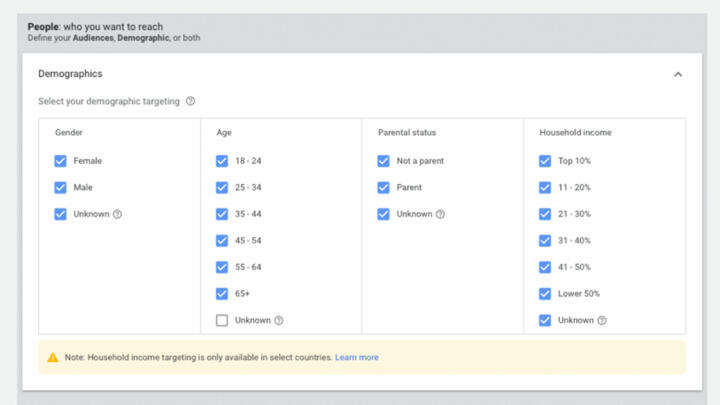
Beyond gender, the primary categories Google offers for targeting ads to some people and not others—what it calls “personalized advertising”—are age, household income, and parental status. For ads for job opportunities, housing, and credit, Google’s rules say advertisers shouldn’t use these categories.
The boxes start prechecked, meaning that in the default mode, gender isn’t taken into account in determining who will be shown the ad, but advertisers can uncheck them, effectively excluding certain categories of people from seeing their ads. That’s allowed for most ads, but Google uses other mechanisms—”internal processes” that Lawal declined to explain—to block job, housing, and credit ads that exclude people by gender, age, household income, and parental status.
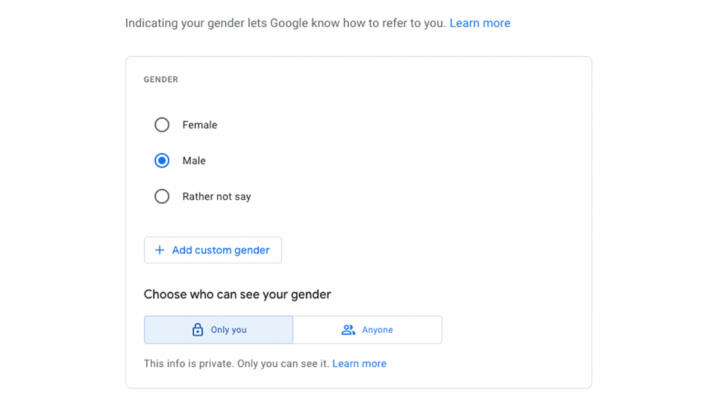
Meanwhile, someone signing up for Google or editing their account settings has four options for reporting their gender: “male, ” “female, ” “rather not say, ” and an option to set a custom gender in a text box.
Lawal said that the “unknown category is intended to refer to individuals where we have been unable to determine or infer the user’s gender and is not intended to allow for targeting or exclusion of users based on gender identity, ” but said that people who choose not to identify their gender or write in a “custom” gender also fall into this category.
Google does offer a way for users to see how they’re categorized for ads, on an ads preferences page.
Google’s options for users amount to putting “a rainbow-colored Band-Aid” on “systems that were not really designed to include nonbinary people, ” said Albert.
“Really the question they should be asking is which gender are you, and which of these gender categories would you like us to serve you ads for, ” and explaining how the ads system uses gender, Albert said.
Allegations of race and sex discrimination have dogged online ad platforms for years. Several year ago, civil rights groups sued Facebook for allowing discrimination in ads for jobs, housing, and credit; Facebook settled the suit and agreed to take those options away. The U.S. Department of Housing and Urban Development (HUD) filed a lawsuit against Facebook too. Last year, HUD announced that it had “worked with Google to improve Google’s online advertising policies to better align them with requirements of the Fair Housing Act.” After those interactions with HUD, Google banned job, housing, and credit advertisers from excluding either men or women from their ads, along with similar rules for age and other protected groups.
While ads for jobs, housing, and financial products fall under special protections, it’s perfectly legal—and very common—to target other kinds of ads to one segment of the population, by age, gender, or other categories.
Those categories are what digital advertisers want, Turow said, so they’re built into the heart of online ads systems.
“The nirvana of advertising in 1994 has turned out to be a big mess in 2021,” he said.