
Post original published in the guardian by Laura Hudson
Through video games, live-action role-playing games and interactive documentaries, developers are challenging the conversation around reproductive rights

Joanne-Aśka Popińska, a Polish woman living in Canada, has created a virtual reality experience called The Choice.
The year is 1972. You’re part of an underground network of feminists in Chicago that provide illegal (at the time) abortion services to vulnerable, pregnant people with few options. Despite the risk of imprisonment, and the ways that your personal experiences may not always perfectly align with your activism, you persist.
It’s emotionally complicated. It’s politically fraught. It’s a live-action roleplaying game by Jon Cole and Kelley Vanda called The Abortionists, which requires three players, one facilitator, six hours and a willingness to dig deep into the painful history of reproductive rights in the United States. That history has terrifying relevance in 2019, as numerous states pass laws that put their residents in a reality where abortion is functionally illegal. Based on the real-life work of a 1970s activist group called Jane, it challenges its participants to think about the “internal landscapes” of its players, and how they deal with the larger political and personal landscape of their world.
As Alabama, Georgia, Kentucky, Mississippi and Ohio work to reverse hard-won reproductive rights with “fetal heartbeat” bills and potential 99-year sentences for performing abortions, game designers in the United States – and around the world – are creating interactive experiences that challenge the simplistic ways that many people think about abortion, and the blunt, often ignorant cruelty of the laws that politicians have drafted around their constituents’ bodies.

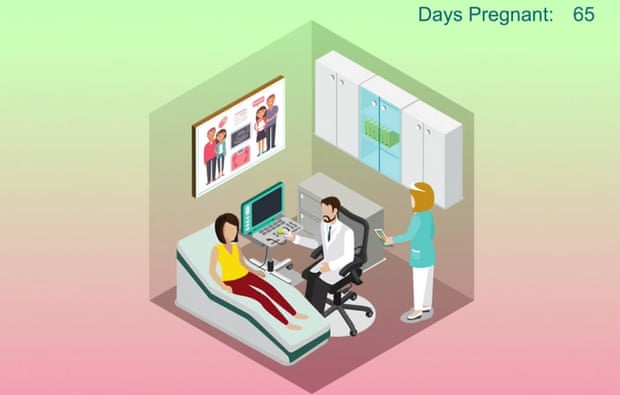
Trapped began as a card game and aims to make players understand the practical realities of securing an abortion.
Trapped began as a card game, developed at Women’s Health Specialists in California, and expanded upon later by participants in the Abortion Access Hackathon. It exists now as a free browser game, and its goal is simple: to make players understand the practical realities of how difficult it can be to get an abortion, particularly when economic, political and cultural factors get in the way.

Get Society Weekly: our newsletter for public service professionals
Read more
Sure, you’ve made the decision that an abortion is the only sensible choice for you, but how far away is your nearest clinic? What complications will it create with your job? How much will it cost? What intentionally prohibitive rules – such as “TRAP” laws, which create arbitrary and medically unnecessary rules to hamstring abortion providers – mean that clinics can’t even function in your state? In Trapped, you wake up in a randomly generated scenario where you want to end your pregnancy and must negotiate the Kafkaesque series of rules and fees that accrue.
“I like the idea that you don’t get to control the situation that comes at you, ” says Katrina Cantrell, who helped develop the online version via the Abortion Access Hackathon. “I want people to understand the relationship of time and money, and how these two variables act on each other. This is why delays in care exist.”
In Choice: Texas, a game that uses the interactive fiction tool of Twine to tell its story, you’re also asked to live out a variety of scenarios through the eyes of five women who discover that they’re pregnant. They come from different economic and vocational backgrounds; they are different ages and races. Each of them runs into different complications in Texas, a state where legislators have actively worked to reduce the options around reproductive healthcare – particularly for the poor and working class.

Choice: Texas presents scenarios through the eyes of five pregnant women.
Created by game developer and historian Carly Kocurek and writer and activist Allyson Whipple, it forces you to decide what you really want, what you are willing to sacrifice, and what it will mean for your future. Can you afford to have an abortion – or afford not to do it? Will your partner be supportive? It doesn’t feel easy, any way you play it.
For Polish game designer Aleksandra Jarosz, the draconian 2016 political effort to further restrict abortion laws in Poland – where abortion is already largely illegal outside of exceptions for rape, incest and fetal abnormality – spurred her to take action. The proposed legislation was spearheaded by Jarosław Kaczyński, leader of the Law and Justice party, who said it was his goal “to make cases of even very difficult pregnancies, when the child is doomed to die because it is severely deformed, finish with birth, so that the child can be baptised, buried, given a name.”
Even in the predominantly Catholic country, this move was a bridge too far. It inspired tens of thousands of citizens to dress in black and take to the streets as well as a strike by women. Days after what was later called the Black Protest, the proposed bill was voted down, but many pro-choice activists in Poland considered it a wake-up call.
As protesters marched in the streets, Jarosz – along with Thomas Feichtmeir, Michael Hartinge, and Sebastian Merk – created Fantastic Fetus: a game that asks you to imagine being pregnant in a world where Kaczyński’s propositions were law. At first glance, Fantastic Fetus looks like a Tamagotchi-style pregnancy simulation filtered through pixelated graphics, where you manage the health, hunger and emotional state of your character through a wanted pregnancy.

Women take to the streets in Warsaw in March 2018 as part of the Black Protest movement against tougher anti-abortion legislation. Photograph: Marcin Obara/EPA
As the months pass, you imagine your child’s future: what he or she will look like, who they might become. But when the baby is born, you discover that it had a fatal genetic abnormality and no chance of survival. Your dreams are shattered, and the revelation is made more terrible by the fact that the state denied you the relevant medical information to make a different choice about your pregnancy that might have abbreviated your suffering or given you any sense of control.
Jarosz says the game, and the decision to include stark images of fetal abnormality, were inspired by a Catholic woman in Poland whose doctor convinced her not to terminate a pregnancy despite severe birth defects, falsely promising that it could be addressed through surgery later. After giving birth and watching her child suffer for months in a hospice and ultimately die, Jarosz says the woman wanted to show a picture of her baby “to everyone who thinks that abortion, in any case, is bad”.
Actually seeing the grim reality of a doomed pregnancy can break through people’s preconceptions and assumptions, even when they oppose abortion, says Jarosz. “After the ending people never just get up and walk away, they always want to stay for a moment think and talk. That is the biggest award we can get.”
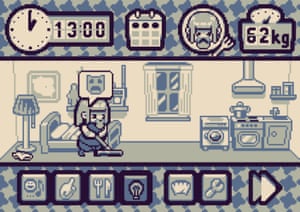
Fantastic Fetus asks you to imagine being pregnant in a world where Kaczyński’s proposed anti-abortion bill had been made law. Photograph: Fantastic Humans
Joanne-Aśka Popińska, a Polish woman living in Canada, was similarly inspired by the Black Protest to develop a virtual reality experience called The Choice where participants are faced with first-person accounts of real people who have had abortions, listening to their stories about how they felt.
Rather than thinking of abortion as an abstract political position, The Choice asks you to look directly into the human faces of people who have faced an unwanted pregnancy. She describes a particularly impactful playtest of The Choice with a developer who had anti-abortion political leanings, and then took off the headset saying, “Congratulations on doing something important … maybe I shouldn’t be so sure.”
Asking people to think, to empathise, to reconsider what it means to have – or not have – an abortion in ways that go beyond political platitudes is a throughline for this wave of games about reproductive rights. In Childfree, a live-action role-playing game created by Axelle Cazeneuve, seven participants act out a decision about whether or not to terminate a pregnancy. This game takes place entirely within the mind of a fictional person whose concerns and conflicts are represented by all of the players collectively.
The facilitator takes on the role of the pregnant person, sitting in a spotlight, while three people in the shadows around them represent distinct elements aspects of “self” (their present situation, their dreams, and their needs) and three others represent elements of “society” (morality, the law, and societal expectations of maternity). The norms involved do not need to resemble any particular society, or any historical one, and can even “become science-fiction” if the players choose.
After answering three rounds of questions by other players to establish their roles, the six elements of the facilitator’s mind can step into the light to either be invited forward to speak or be refused. At the end of the game, the facilitator weighs all the complicated and personal factors, and announces their decision. It’s an engaging, emotionally complex look at the knot of internal and external forces that surround decisions about termination. It explicitly insists that while continuing a pregnancy is a perfectly valid choice and that people’s experiences vary wildly, ending a pregnancy does not have to be inherently traumatic.

Viewers of The Choice, a VR documentary, hear stories from people who have chosen to have an abortion.
For Cazeneuve, motivation came from her own experience. When she discovered that she was pregnant in early 2011, due to a problem with her IUD, she knew immediately that she wanted an abortion. Although she had never wanted to be a parent, she had always feared that she “wouldn’t have ‘the strength’ to abort” if she experienced an accidental pregnancy. When confronted with the situation, however, her decision was clear.
“When I became pregnant, I realised that I, in fact, didn’t have to feel bad about choosing an abortion, ” says Cazeneuve. “That it was a part of a contraceptive process, the last resort, the step you wish you wouldn’t have to take, but is here anyway, just in case all the rest fails.”
Despite living in France, where it is relatively easy to get an abortion compared with many other countries, she describes her pregnancy as “an eye-opening experience”.
She began working on a live-action role-playing game that reflected a variety of experiences around abortion, but pivoted to creating Childfree when she came across two other Larps that weren’t explicitly anti-abortion but used “the future of the potential child” as narrative motivation. “This felt deeply wrong to me, ” says Cazeneuve. What mattered more, she felt, what needed to be centered and given more weight, was not the “potential” of an embyro but the life of the human being carrying it. “This is a humanist issue. Live-action role-playing, as a medium that fosters agency among its players, is a tool we can use to make people more deeply aware of that, ” says Cazeneuve. “Unlike theatre, Larp maintains the agency of the subject – the player playing the pregnant person – and that was crucial to understand the topic.”
For many people making games that address reproductive rights, the goal is not to force players to accept a single perspective or conclusion, but to contend with the numerous tangible, personal experiences of people dealing with unintended pregnancies. Most of all, they ask players to consider the very real human beings trying to make difficult decisions about abortion. These people are often erased by simplistic, judgmental political stances – or legally prevented from making those decisions altogether.
“What I aim for is just making people more aware of how we receive and process norms, and how deeply we are affected by them, ” says Cazeneuve. “I also aim to show that they always have a choice, even when everything seems to be against them.”