INTERVIEW WITH SPIDERALEX
We need to break the digital monoculture and challenge Big Tech in their relentless drive to transform our digital environment in its own image. Digital Earth conducted interviews with artists, technologists and activists, who work towards building a pluriform and inclusive digital environment. Our main question: How can we break the digital monoculture and build a more humane digital future?

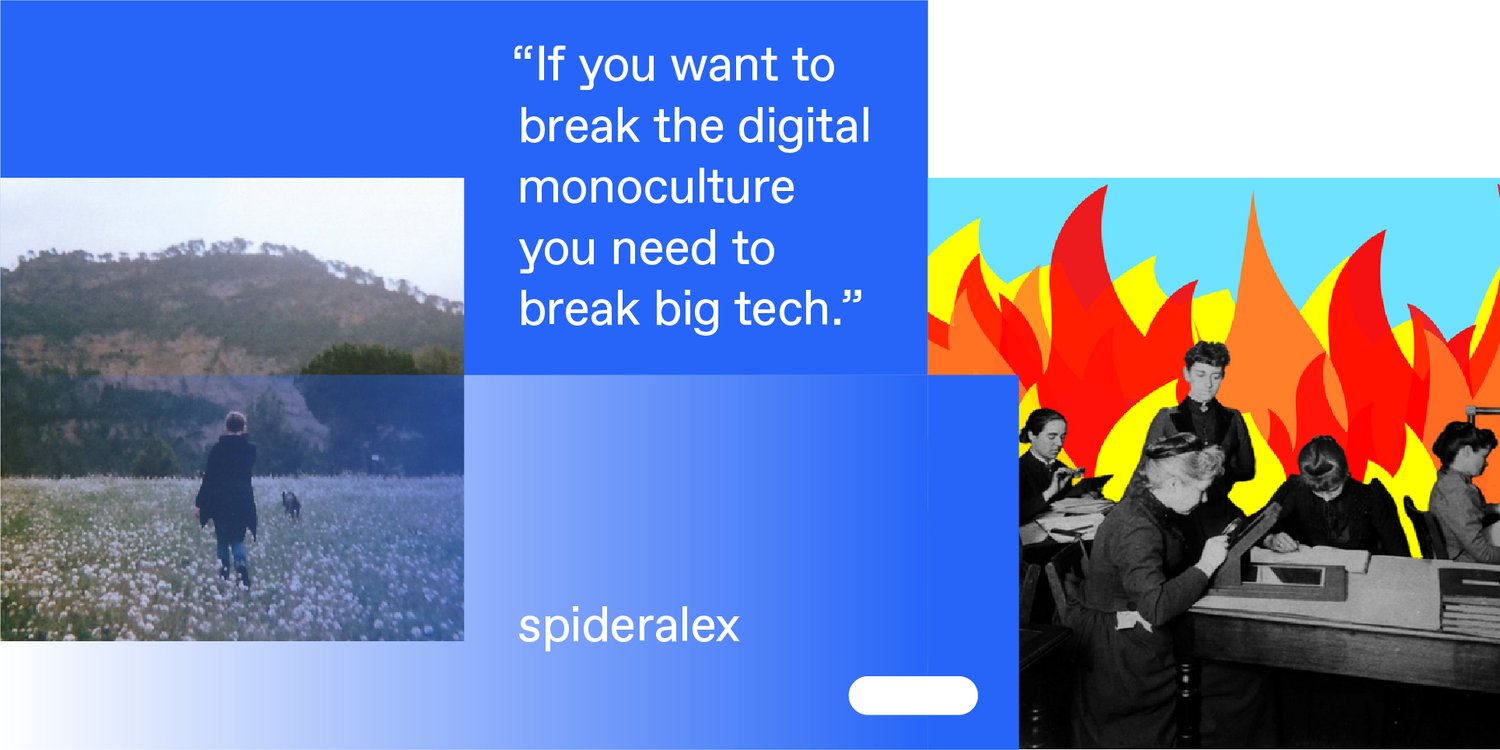
This image depicts the women from the Harvard Observatory, under the direction of Edward Charles Pickering (1877 to 1919) who had a number of women working as skilled workers to process astronomical data. Harvard was the first such institution to hire women to do this type of work. Among these women were Williamina Fleming, Annie Jump Cannon, Henrietta Swan Leavitt, and Antonia Maury. Although these women started primarily as calculators, they often rose to contribute to the astronomical field, and even publish in their own names. This staff came to be known as the Harvard Computers or, more derisively, as «Pickering’s Harem». This was an example of what has been identified as the «harem effect» in the history and sociology of science.
Spideralex holds a master degree in sociology and a PhD in economics. She has founded the collective Donestech that explores the relation between gender and technologies developing activist research, documentaries and training. She is also the editor of two volumes about the panorama of technological sovereignty initiatives. She enjoys doing holistic security and speculative fiction workshops. She is part of AnarchaServer, a feminist server.
How did you come to work combining academia and activism that’s focused on feminism and technology for social and political transformation?
My academic training is in sociology, social economy, and urban sociology. I have been studying how urban social movements struggle against gentrification, particularly in Barcelona. Barcelona has been a laboratory for gentrification in Europe since the 90s and attracted people that were passionate about urban sociology. This was in the early 2000, when the internet also came around, and I changed from sociology and urbanism to do my PhD on how social movements use and build information and communication technologies (ICT) to fight and organise resistance. I was lucky to be in Barcelona which, at the time, had many hacklabs in squatted social centres where people could come and learn about free technologies and free software.
Currently I do research about the contribution of women and non-binary identities to the development of technologies and hacker culture. I am also involved in setting up workshops and trainings about feminist self-defense in the digital spaces. Right now, we are working on setting up a feminist helpline to provide support to people that are facing gender based violence in digital spaces, or gender based violence is enabled or amplified by ICT. I’m also a part of a feminist server called AnarchaServer where we learn to sysadmin and set up online services for other feminist collectives. And besides that, I’m also part of a community where we have a social lodging cooperative and different projects. During the last 10 years, we have been buying an old textile factory space which we are rehabilitating on our own doing a lot of physical and material work, but at the same time organizing events that relate to free technologies, political appropriation of technologies, and political critical citizenship.
What is your main research question that motivates you in your practice?
It’s difficult to summarise in one question, but I think it would be “how can we break the cycle of hopelessness?” In the beginning there was a lot of hope for the empowering potential of these technologies. In the last 15 years, the model has completely changed with the commercialization and centralization of the internet, international surveillance, and the polarization of the users. This has been a big disappointment for activists that really thought that they were now going to have a medium that would support the agenda of social movements and enable political and social transformation; an internet that is going to be changing things.
Now I centre on how to create methodologies to help people to reclaim the power of non-dystopian narratives. So, to train our brains to envision the possibility of imagining and desiring the technologies that we deserve and how to envision and reclaim better futures. The dystopian narratives really took up all the space. With the pandemic – where I have not been able to do this work – my brain was frozen. So my question is how we can break the cycle of hopelessness?

Courtesy Sra Milton
Staying with the state of hopelessness, how would you characterize that?
This is a philosophical question. We are one of the first generations that feels that we might be the last generation walking on earth. That’s something very new in the evolution of humankind. It’s heavy and it’s something that we don’t talk much about.
And you’ll see that big tech is amplifying that state of hopelessness and cultivating it. I’m so mad at big tech. A new disheartening, emerging narrative is that big tech is gonna save us from climate change. That is totally bullshit. It cannot work. Even if they weren’t gonna scale all those big technologies, they would not be able to get the minerals they need cause we are not only facing a peak oil situation but a peak everything situation. The circular and recycling economy is broken. So it is clear this greenwashing propaganda is delaying a collective thought process on how we can transition to other types of societies. For me it is a very straightforward question; if you want to break the digital monoculture you need to break big tech. And as Cory Doctorow has explained breaking big monopolies is a slow, legal, boring process
I think that the NGO world and the social transformation of civil society should be at the forefront of reappropriating the political dimensions of technologies. They should question who those technologies are hurting and exploiting from a political and ethical perspective. And by “who” I am referring to humans but also animals and natural ecosystems. These organisations should not assert themselves as passive. We need to do two main things, break down monopolies by law and propel those spaces to have a political and creative appropriation of technologies.
Social justice organizations are struggling to get out of big tech’s web. What would you tell those organisations or even people facing the issue of ‘de-googling’ themselves?
It’s a work of patience and a labour of love. If you don’t have mental space or time, you’re not gonna be able to take some distance and reflect on a different approach. It is always better to have a collective approach to those questions, because it creates social cohesion.
I think that the food sovereignty movement has been really successful in their creative approach to express the need for ecological, slow, and fairly produced food. They made people focus on the positive values of food consumption and think critically around them. We really need to bring these elements to technology and start asking what kind of technologies we are consuming.
This is also important when looking at how technology is produced. Who are the labourers, where are the minerals extracted? This chain of production is propelling so much violence, generally against women, kids and natural ecosystems. It is incredible how we carefully label whether or not our food is fair trade, and not apply this to the chain of technologies we are using. I don’t necessarily have a solution, I don’t have a computer that is gonna last forever and that doesn’t contaminate like its trade. But I want a computer that is produced in good conditions, can be repaired and recycled forever.
The problem right now is that there are less people involved and engaged with the theorisation and activism of the problems of big tech in comparison to the food sovereignty movement.

Courtesy Cooperativa Kéfir
You have also been looking into online violence against women and cyberfeminism. How can we work with feminist principles to oppose big tech. What principles are you working with and how do you implement them?
There are a lot of different kinds of feminisms. For me, feminism is everyone having the same rights and opportunities. We should never forget that women have been the most oppressed political subject throughout history. Not just here in Europe, but everywhere. Feminism should be anti-colonial and anti-capitalist and it is a struggle for all women. It also includes the right to opt for any gender identity and sexual orientation.
In relation to technology, investigating its HerStory is important. Women and non-cis people have been apart of it since its beginning, yet they have not been written into the “history” of its development. This is really important because the current narrative gives the impression that tech is a white, male, military enterprise and that women have not participated in the development of technologies. If we don’t make this HerStory visible, we won’t create the possibility for all people to understand that they are part of it and that this also matters to them.
Also, since 2010, there’s been a rise in gender based online violence and harassment. These conditions force many women and feminists collectives to organize and to understand how these new forms of violence and harassment are silencing them and limiting their possibilities to use certain technologies as a medium for their own agenda. And most importantly, how do they push back and resist the detrimental effects of this. Now there’s a feminist self-defense in digital spaces. There are lectures, training, workshops, and internet standards and protocols from a feminist perspective. The resistance has created feminist circles and feminist infrastructures.
But there’s still a big divide between the feminist movements in general. More feminist movements are coming on board in working with the importance to reclaim the digital space. There’s a normalization of hate speech and violence on the internet. That’s crazy, because this is not the case for street violence. The streets might be violent, but they should not be, and we need to reclaim the street. This is exactly the thought we need on the internet; the possibility of it being a safe space.
Technology enables feminist movements to inform, communicate, create relationships, to document and create memory. The current comercial social media platforms where this work is done are very often created or designed by misogynists. You cannot rely on these to have a human and women’s rights agenda. Many feminist collectives and movements are not seeing the possibility of building and using their own infrastructures in order to do their work in safe spaces. I mean, feminists are already working with so many important and urgent issues, so this work demands some mental space. However, building feminists digital infrastructures is far from a trivial quest, it is crucial to the work we do.
You have worked in depth with speculative fiction. Why is it so important to imagine radically different technological futures and what can we learn from speculative fiction?
Feminist techno-speculative storytelling is fiction and design gestures towards a set of geographies of the imaginary and of their materiality deeply inspired by social justice and political transformation. Walidah Imarisha illustrates this point when she suggests that “whenever we try to envision a world without war, without violence, without prisons, without capitalism, we are engaging in speculative fiction.” Doing speculatively is political as it involves one of the multiple ways to re-imagine technological and infrastructural entanglements that shape our world. It also serves to expose technologies and infrastructures that have furthered (neo)colonial processes such as the stealing and erasing of indigenous scientific knowledge and techniques, and the shattering of liberation struggles. By shedding light on these contradictions, doing speculatively also attempts to de-privilege and de-glorify science and technology. De-privileging the assemblage of humans and technology (non-human) echoes the act of making visible and valuing other types of assemblage with the non-human, such as with land, animals and plants. Doing speculatively is infrastructural as it allows for the circulation of ideas, fabulations and dreams among others. It is also about healing and affect. It requires people to care enough about feminist technologies to dream about them in order to better build them. For stories to act as potential agents for transformation, they need caring, appropriate and affective infrastructures to shelter them.
If you would pick one example of a work that you find of particular importance in imagining a radically different future beyond the imperative of the digital monoculture, what would it be?
I would not talk about one artist but the artistic production of cyberfeminist groups and collectives. I try to map those and include it in our repository of collective memories in AnarchaServer, you can visit for instance the cyberfeminist folder in the repository to see what kind of artistic production I am referring to. Another very important source of inspiration is feminist science fiction and afrofuturism, I would invite anybody interested in explorting other non dystopian pathways about other possible realities, technologies, futures, to start there. Enjoy the journey!