
A spreadsheet on ad platform Xandr’s website revealed a massive collection of “audience segments” used to target consumers based on highly specific, sometimes intimate information and inferences
What words would you use to describe yourself? You might say you’re a dog owner, a parent, that you like Taylor Swift, or that you’re into knitting. If you feel like sharing, you might say you have a sunny personality or that you follow a certain religion.
If you spend any time online, you probably have some idea that the digital ad industry is constantly collecting data about you, including a lot of personal information, and sorting you into specialized categories so you’re more likely to buy the things they advertise to you. But in a rare look at just how deep—and weird—the rabbit hole of targeted advertising gets, The Markup has analyzed a database of 650,000 of these audience segments, newly unearthed on the website of Microsoft’s ad platform Xandr. The trove of data indicates that advertisers could also target people based on sensitive information like being “heavy purchasers” of pregnancy test kits, having an interest in brain tumors, being prone to depression, visiting places of worship, or feeling “easily deflated” or that they “get a raw deal out of life.”
Many of the Xandr ad categories are more prosaic, classifying people as “Affluent Millennials, ” for example, or as “Dunkin Donuts Visitors.” Industry critics have raised questions about the accuracy of this type of targeting. And the practice of slicing and dicing audiences for advertisers is an old one.
But the exposure of a collection of audience segments this size offers consumers an unusual look at how they and their families are packaged, described, and categorized by ad companies.
Because the segments also include the names of the companies involved in creating them, they also shed light on how disparate pools of personal data—collected by tracking people’s online activity and real-world movements—are combined into bespoke, branded groups of potential ad viewers that can be marketed to publishers and advertisers.
How do advertisers think of you?
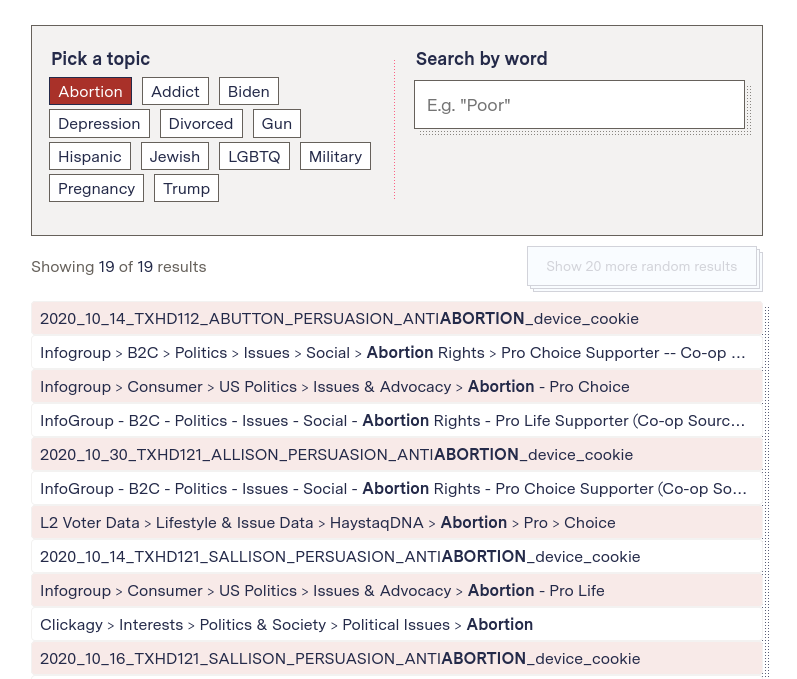
In a newly discovered database on the Xandr ad platform’s website, The Markup found thousands of rows of data that indicate sensitive consumer groupings known as “audience segments.”
Select a search term to see a sample of results using this ad term. Or, search the data for any keyword.
Note: Some segments from data suppliers Grapeshot, Peer39, and others found in this dataset are “negative keyword” or “brand protection” segments that are used to control when an ad should not appear, rather than “audience segments, ” which are lists of IDs associated with consumers.